DMS in the cloud

Efficient cloud DMS solution thanks to container technology
What is a cloud DMS?

A cloud DMS (document management system) is a software solution that enables organisations to digitally organise, store, manage and share their documents.

Unlike other traditional, locally (on-premise) installed document management systems, a cloud DMS is hosted in the cloud and offers advantages in terms of accessibility, scalability, security and collaboration.
ELO DMS as cloud hosting from Open7

Cloud DMS mit Container Technologie

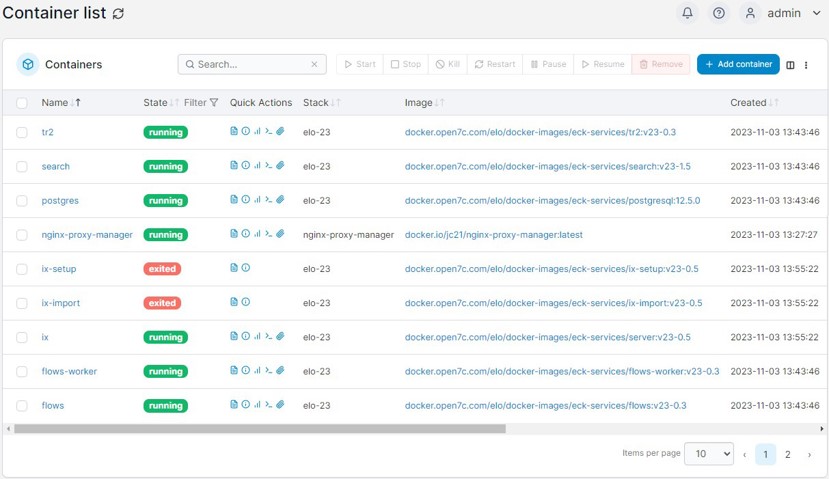
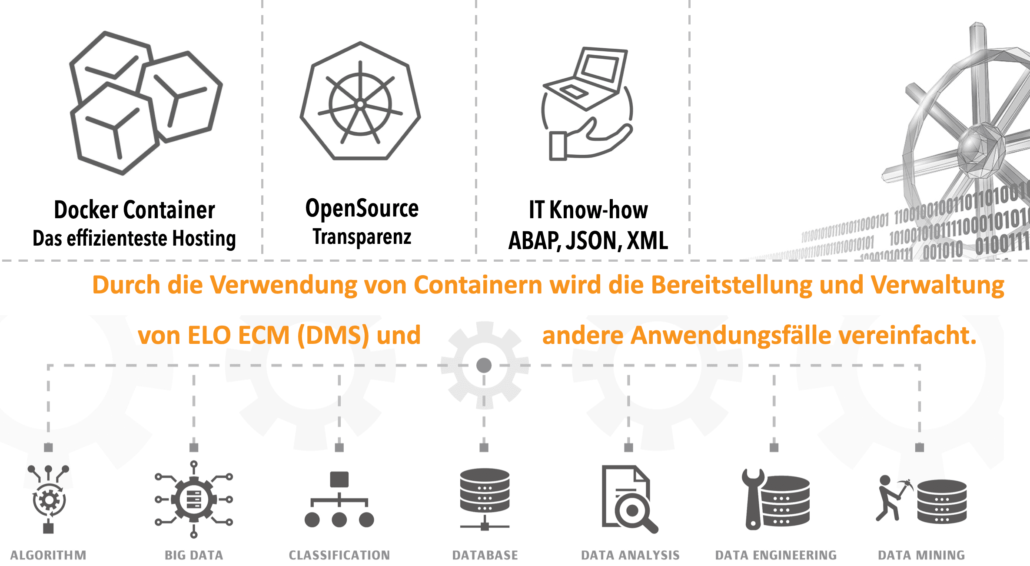
Thanks to Open7’s comprehensive expertise in container management and provisioning, the ELO ECM Suite can be easily installed as a cloud-based DMS for any company. The cloud DMS can be deployed as either a private or public cloud. This is made possible by the use of Docker containers and, in the future, Podman containers. Installing ELO as a cloud DMS using Docker and Podman containers not only makes installation much easier and more efficient for customers, but also much more cost-effective. If you want to combine the advantages of private and public cloud solutions, this is also possible with a hybrid solution. This combination option also makes it particularly easy to customise and scale ELO to your needs.

Are you looking for an efficient and comprehensive solution for managing and archiving your company’s data that can be accessed from any location and integrates seamlessly with your SAP system? ELO DMS for SAP, a cloud-based document management system available in a private or public cloud, is the perfect solution!

What advantages do Open7’s cloud DMS solutions offer?

  • Flexibility and mobility

    Open7’s cloud DMS solutions offer a range of benefits that improve both the efficiency and security of document management in modern businesses. A key strength lies in the accessibility of documents from any location, as long as an internet connection is available. This flexibility and mobility enable users to work seamlessly, regardless of their location.

  • Security

    The protection of sensitive data is ensured by means of ongoing measures such as encryption, access control and compliance with data protection standards.

  • Scalability

    Another important aspect is scalability, which enables companies to adjust resources as needed. This is particularly advantageous in times of growth or changing requirements.

  • Increase in efficiency

    The automation of document management processes and workflows is another key feature. It increases efficiency and minimises human error. The ability to collaborate in real time also promotes teamwork. Multiple users can work on documents simultaneously, making changes, adding comments and sharing.

  • Versioning and management

    Versioning and storing different document versions makes it possible to track changes and access older versions. This feature is extremely valuable for document management.

  • Cost savings

    Using Cloud DMS brings significant cost savings, as there is no physical infrastructure, server maintenance or operating costs.

  • Backup and Revovery

    As a cloud DMS provider, Open7 offers backup and disaster recovery services to ensure document integrity and availability. These services are crucial for business continuity and protection against data loss. Overall, cloud-based DMS solutions provide a powerful, efficient and secure platform for managing documents in a connected world.

Is Open7’s Cloud DMS solution audit-proof?

Yes, ELO has been certified internationally by various economic institutes and has been recognised as audit-proof for authorities and government agencies. The procedural documentation is based on the requirements of the General Data Protection Regulation (GDPR) and serves to document the processing of personal data in order to ensure compliance with data protection laws. This may be required and interpreted differently by the authorities in certain countries.

Procedural documentation is therefore recommended for your own company so that you can efficiently track all documentation procedures over a longer period of time as part of your own duty of care.

Private-Cloud vs. Public-Cloud DMS

Private cloud and public cloud are two fundamentally different approaches to providing cloud computing services, each with its own advantages and disadvantages.

Private-Cloud

A private cloud is a dedicated infrastructure that is created and used specifically for one organisation. It can be operated on the company’s premises or hosted by a third-party provider, but it is used exclusively by that particular organisation. In a private cloud, the organisation has full control over resources, security policies and data protection regulations. A private cloud is therefore particularly interesting for companies with strict compliance requirements. However, operating a private cloud usually requires higher investments in hardware, software and operating costs compared to a public cloud.

Public-Cloud

In contrast, the public cloud is a shared infrastructure that is operated and managed by a cloud service provider. This infrastructure is made publicly accessible via the internet and can be shared by different organisations. With public cloud solutions, resources and services are provided by the hosting provider, offering companies a flexible and scalable solution. The public cloud offers cost efficiency by sharing infrastructure costs and enables rapid scaling as needed. However, companies share the infrastructure with other users, which potentially raises concerns about security and data protection, especially in sensitive or regulated industries.

Overall, the private cloud represents a tailored, controlled environment for specific business requirements, while the public cloud offers a cost-effective and scalable solution for a broad user base. The choice between the two models depends on individual requirements, security concerns and resource availability, with many companies often considering hybrid approaches to benefit from the advantages of both models.

Doc-text Doc-text

NEED MORE INFORMATION?

Please write to us using our contact form or contact our Sales Manager Manfred Trojan directly for a personal consultation.

Manfred Trojan

Sales Manager & Technical Assistent

E-Mail: manfred.trojan@open7c.com

Phone: +43 670 404 9330

WordPress Cookie Notice by Real Cookie Banner